
G4BB 79: Yes, We Now Have Grand Cousins

Yes, We Now Have Grand Cousins

79.1  I have on numerous occasions at this blog advocated the Spanish language system of referring to collateral relatives…that is, the “2nd uncle/nephew” formulation, instead of the confusing “cousin removed ascending/descending” system we use in English. The key feature of the Spanish system is that it describes how each collateral relative is related to you…everyone in your father’s generation is an uncle to youuncle, 2nd uncle, 3rd uncle, etc. Everyone in your son’s generation is some type of nephew to you….then grand uncles for your grandfather’s generation, grand nephews for your grandson’s generation, and so on.

79.2  On the other hand, the English system literally describes how a collateral relative of yours is related to someone else…then it must be inferred how that someone else is related to you. For example, “3rd cousin twice removed” means your grandfather’s 3rd cousin…and this individual is related to you because your grandfather is related to you, as your father’s father. Ultimately, it amounts to the same thing as in Spanish, except that in English all generations are your “cousins.” But in everyday life, you’re likely to call your father’s 1st cousin your “uncle,” not your “cousin”…and sure enough, in Spanish he is your uncle…your 2nd uncle.

79.3  But you may have noticed that sometimes when I recommended this Spanish terminology, I made it clear I wasn’t recommending the Spanish kinship system in its entirety…because it has its own unenviable quirks, and now you know what they are…no agreement as to how to describe relatives as basic as your direct line…your father’s father, your father’s grandfather, your grandfather’s grandfather, etc. English is as straightforward as could be…”father” is back up the tree, “son” is down…and to go further, start with grand, then add a great for each successive generation. Repetitive, but pithy…completely logical and universally understood. We got it from the Germans.

79.4  But whereas the great/grand compounds begin after the father/son generations…with grandfather and grandson…in Spanish they do not…there are separate words for grandfather…abuelo…and grandson…nieto. That’s 4 different words (padre, hijo, abuelo, nieto)…because Latin had 4 different words…OK, hardly the end of the world. Start the compounds after the grandfather/grandson generations. And they do, with bisabuelo and bisnieto for great grandfather and great grandson. But then what? A different compound, either tatara-  or rebis- for the great great grand generation…and after that? Multiple tatara-‘s…or else ordinals like cuarto–, qunito-, sexto-, etc. Notice that as a result, the T’s for tatara-‘s are always 2 less than the G’s for greats.

79.5  Or else you can start the ordinals with great grandfather as segundo abuelo. The Guardians of Spanish Language Purity support that method, but they are hopelessly ignored, or not, either by custom or whim. And then those kooky Chozno‘s make their entrance. As a practical example of the resulting Babel, consider this website…Justificacion de Porque Todos Somos Primos. I confess I can’t make out whether this person is trying to make a valid point about kinship theory, or is just a crackpot. Google’s “English” translation is no help…altho it does yield some amusing whoppers, like “16 new-born ancestors”…”We jumped a family”… and “Today it is very strange marriage between uncle and sob flour.”  BTW, did you know that “When they marry together 2 first cousins, their children lose a grandparent”…which almost makes sense in a loopy sort of way. But what the heck are “April 31th grandparents”…???

79.6  The above excerpts are all plucked from Julio Cesar Garcia Vasquez’ thesis, and if you contrast and compare, you’ll see no rhyme or reason. Notice now that chozno is not simply a special word for a degree of grandson but is also applied, unfettered and unsullied, to a degree of grandfather. And we spy still more terms, not in our basic Chart 272 listing…trisabuelo, tris-abuleo, bischozno, trischozno, tatarachozno…is there no end?  Alas, read on…

79.7  This is hardly a recent phenomenon…our next set of excepts (above) are from a book of Spanish grammar published in 1902…add to our hyper-inflated vocabulary bis-abuelo for bisabuelo…both tri-abuelo and triabluelo…tras-abuelo and trasabuelo…and the double-hyphenated tras-bis-abuelo for trabis–well, you know. Uncles and nephews get in on the fun with bis-tio, bistio, tri-tio, tritio, bis-sobrino, and, you guessed it, bissobrino. Bssssssssss indeed! But as the infomercial pitchmen say, We’re Not Done Yet!

79.8  Because there’s one school of thought out there that would retreat back one ancient civilization, from the Romans to the Greeks… with pentabuelo, hexabuelo, heptabuelo, etc. I wouldn’t mind if it were just one outpatient make these suggestions, but, for example, pentabuelo gets 551 Google hits, which is 551 too many. ¿¿¿ What, no tetra- ??? Notice also, 7 different choices for great great grandfather, while only 6 are given for great great grandson. And if neither trasabuelo nor trisabuelo suit your fancy, try tresabuelo on for size.

79.10  But what makes this mess all the worse is the fact that unlike in English, where “grandfather” contracts to “grand” to form “grand uncle,” your grandfather’s brother…in Spanish, the whole  “grandfather” word, whatever it may be, is used …as in great grand uncle being literally “great grandfather uncle.” And so, for example, which is it for your 3rd great great grand uncle, the 2nd cousin of your great great grandfather…tio tatarabuelo tercero…tio rebisabuelo tercero…tio trasbisabuelo tercero…tio tercer abuelo tercero… or even tio abuelo tercero tercero for gosh sakes. It certainly gets dark early around here, doesn’t it?

79.11  Yes, Spanish simplifies the compounding of collateral terms…English uses both “removed” and “grand/great”…Spanish limits it to just “grand/great.” But lacking the streamlined convention of just those 2 words…great and grand…it ends up flying all over the place. The embarrassment of riches that plagues your direct line spills over into your collaterals, up, down, and sideways, tios y sobrinos.

79.12  You know, it gets so crazy, it almost makes me think I’m missing something…still, you must come back to the fact that in English, there is simply no other way to say “great great grandfather”…except for abbreviations like “2G grandfather” and “2nd great grandfather.” Using the terms “2nd uncle” and “2nd nephew” in English is not so much a translation from Spanish per se, as an adaptation of the idea…as we have seen, literal translation couldn’t be more unwieldy.  Ironically, then, the Spanish language method of denoting collateral relatives is a good fit when adapted into English…but not so good a fit within Spanish itself. Still, people can get used to anything…consider “significant other”…or Spiro Agnew…

~~~~~~~~~~~~~~~~~~~~~~~~~~~~~~~

79.13  But I believe I promised you some grand cousins, nez pah? The method of using “grand” and “great” to count both forward and backward in your direct line is a very succinct one, compared to the other example we’re been examining…obviously. It could be further simplified by calling your father’s father your “great father,” and your son’s son your “great son”…and it wouldn’t surprise me if a language in the Germanic family does just that. In fact, English does that with “great uncle” for your father’s uncle, your grandfather’s brother. Genealogists prefer, and many native speakers of English naturally say, “grand uncle” instead…and indeed, one of the best arguments for “grand uncle” over “great uncle” is that we have a “grandfather,” but no “greatfather.”

79.14  If you ever wondered why we don’t extend the great/grand beyond father/son/uncle/nephew, it’s due to an asymmetry that you probably never noticed, altho you’ve used these English kinship terms since you learned to talk. And that asymmetry is this: your son’s brother is called your “son”…but your father’s brother is not called your “father”…but instead your “uncle.” So who would be your “grandbrother”? Now we have the same ascending/descending ambiguity as with “1st cousin once removed,” but passing over that, your “grandbrother” could be your uncle…and also your brother’s son, what we would call your nephew.

79.15   But now, your son and your “grandbrother” are of the same generation…indeed they are 1st cousins….which is to say, your grandson and your “grandbrother” are of different generations. So the grands are now out of whack…going down one more, your grandson and “great grandbrother” are of the same generation, as are, going up, your grandfather and your “great grandbrother” (your grand uncle). This defeats the purpose of lining up generations based on the number of greats and grands…and it’s no wonder this terminology never developed. The same disconnect that occurs with “grandbrothers” affects any attempt at “grandcousins” as well.

79.16  The way out of this would be to call your grandfather’s brother your “grandbrother”…but then what would that person be to your father? Not to mention your father’s brother to you? Going the other way, your son’s brother could be your “grandbrother,” but then all your sons would be your “grandbrothers,” as they are all brothers to each other. Well, the answer to the first part could be “uncle”…and as to the second part, if your son’s brother is your “grandbrother,” your brother’s son would have to be something else…maybe your “nephew”…or should that be “grandcousin,” since he is your son’s cousin…except then what is your cousin’s son? At any event, we’re back to uncles and nephews, so expanding the great/grand compounds landed us nowhere. Nope, the English language had it “right” the first time…and who said it isn’t “logical”?  😉 😉

79.17  Still, never say never, as they say. I found Chart 275 while researching this stuff. Left-clicking on it will make it larger and easier to see. We tend to associate Romance Languages with countries…Spain, France, Portugal, and Italy. Interestingly, and I didn’t know this, Romanian is also derived from Latin. But there are many other Romance Language, among them Aragonese, Arpitan, Asturian, Catalan, Corsican, Friulan, Galician, Ladino, Leonese, Lombard, Mirandese, Neapolitan, Occitan, Piedmontese, Romansh, Sardinian, Sicilian, Venetian and Walloon. Many of these are often thought to be dialects of other more widely spoken languages, even by those who speak them…but apparently linguists consider them all true languages, due to differences in grammar and vocabulary, as well as pronunciation.
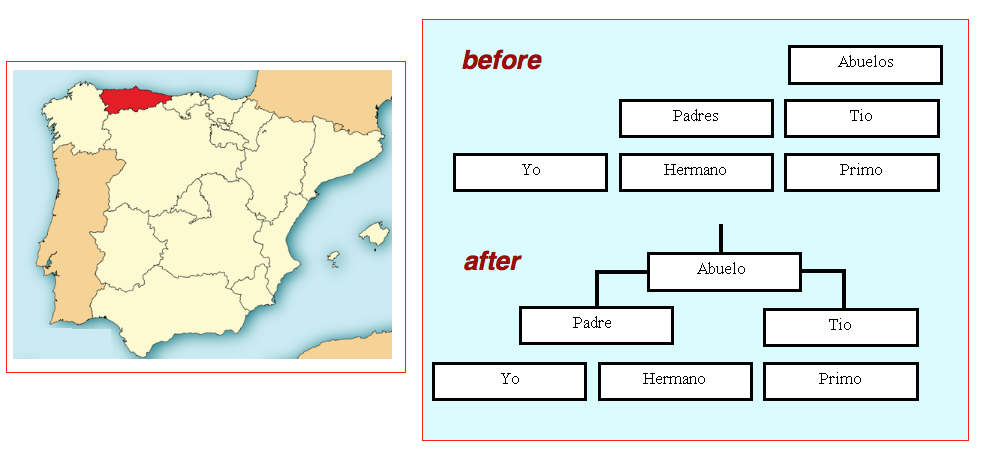
79.18  Chart 275 was said to be the kinship terms of the Asturian language…altho it is in fact written in Spanish. I present it here as I found it, with 2 changes…the founding anscetor of each “cousin line” has been moved over and connected downward…as seen above on the right…on the left is a map showing the location of the what is today the Spanish provence of Asturias.

79.19  And whoever put this diagram together was getting a little punchy near the end, as there are 4 errors on the far right  side (in yellow). Above in pink are the corrections. And as you peruse this fascinating chart, it will be helpful to understand the abbreviations used here for Spanish ordinals. As in English, it is simply the numeral followed by the last 2 letters of the word. 2nd is 2do for segundo…3rd is 3er for tercer when used before a singular masculine noun, 3ro for tercero in all other cases…4th is 4to for cuarto…then continuing with -to for quinto and sexto.

79.20  I have translated Chart 275 into English as Chart 276…and what we find is sort of a hybrid between the Spanish and English kinship systems. As in Spanish, there are no “cousins removed”…generations up and down are instead indicated by great/grand…in Spanish, the non-contracted grandfather (abuelo) and grandson (nieto) and their compounds. But instead of these collaterals being uncles and nephews…2nd, 3rd, 4th, etc….they are cousins! The ascending/descending ambiguity doesn’t come into play, since direction is shown by the 2 forms of “grand”…abuleo and nieto.

79.21  But now, the first level of great/grand is indicated by “uncle/nephew,” used as an adjective instead of as a noun! Thus your 2nd cousin’s son is your nephew 2nd cousin…while your 2nd cousin’s  father is your uncle cousin (that is, uncle 1st cousin)…and his father is your grand uncle. Yes, sometimes uncle/nephew is the modifier, sometimes its what’s being modified. Didn’t see that coming, I betcha. And as in English, using for example the “cousin line” for your 4th cousin, down from him all descendants are some degree of 4th cousin, while going up from him towards your 3G grandfather, they are degrees of cousins counted backwards…3rd, 2nd, 1st…then 2G uncle, brother of your 2G grandfather, both the sons of your 3G grandfather. I have summarized these Cousin Lines in Chart  277. 

79.22  But yes, in Asturian, you do have grand cousins, up and down, as I’ve highlighted below in blue and yellow boxes respectively. The idea of exploring in detail these systems, and their origins, development, and relationship to one another, certainly appeals to me…for now, my overall plan is to find and wed an extremely wealthy widow…one who is too proud to have any husband of hers work for a living! Queries from the mailbag are overdue, and we’ll delve into the pile next week…bliss out…

________________________________________

Copyright © 2012 Mark John Astolfi, All Rights Reserved

plugs that remain, now and forever, and in every known language, shameless…

Other  Blog at http://stolf.wordpress.com  (the legendary Stolf’s Blog)

Podcasts at http://stolfpod.podbean.com  and   http://thewholething.podbean.com

More bloggage at  http://travelingcyst.blogspot.com

Updated Resume at http://travelingcyst.blogspot.com/p/resume.html

Audio samples at  http://stolfspots.podbean.com

Posted in \baby boomers | Leave a comment

G4BB 78: Meet Señor Hoarfax

Meet Señor Hoarfax

78.1  I should explain today’s title…it all starts with a feisty old character actress named Jesslyn Fax. She died in 1975 at age 82. She’s one of those ones you see in lots of old TV shows and movies…you instantly recognize her, but probably don’t know her name…except now you do. Her first name sounds pretty modern, doesn’t it…along the lines of Ashlyn, Jaclyn, Shaylyn, and countless other creations. And why is her last name Fax…they didn’t have electronic facsimile transmission when she was born in 1893, altho it does originate from 1914, perhaps further back than you might have thought.

78.2  So here’s the story…the surname Fax has at least 2 different origins…it can be a re-spelling of Fox. It is also an Old English word, originally feax, meaning “hair,” or more specifically a “head of hair.” In Old Norse it means “mane.” It survives today in such names as Fairfax (“light-colored hair”) and Colfax (“black hair”…i.e. coal)…altho not in Carfax, which is from the French carrefour meaning “crossroads” or “junction. J. R. R. Tolkien got into the act, naming a horse in “Lord of the Rings” Shadowfax, suggesting “gray hair.”

78.3  But is this even her real name? Yup, pretty much…she is listed in the 1901 Canadian census as “Jess E. Fax,” daughter of James and May Fax of Toronto. So anyway, to the second part…hoar literally means white or gray, as hoarfrost…figuratively, old or ancient, as hoary (“old and gray”)…and by extension, worn-out, overused, stale, as a hoary joke or hoary analogy. I put them together to get “gray hair”…or more like “graybeard,” an old guy…and that’s today’s topic.

78.4  Because as admirably as the Spanish language deals with collateral relatives…replacing the confusing “cousin removed” formulation with “2nd uncle/nephew,” it is ironically all over the place when referring to one’s direct ancestors…in short, there is no universally accepted system.

78.5  Everyone agrees that abuelo and abuela mean “grandfather” and “grandmother.” There is no word for “grandparents” as such, so it reverts to the masculine los abuelos. This is not surprising, since Spanish is a Romance Language, and these words derive from the Latin avus and avia. But it also means that going back further, you don’t have the simple great/grand convention of English, which in turn comes directly from German, where great grandfather is urgroßvater…that letter that looks like a capital B is an eszett or “sharp s” and represents 2 of them…”ss.” From there you simply add ur‘s…great great great grandmother for example is ur ur urgroßmutter. Sometimes you’ll see hyphens…like ur-ur-ur-…but without hyphens is considered standard, as it is in English.

78.6   As to great grandfather in Spanish, bisabuelo is as universal as it gets, altho there is a school of thought that prefers ordinal numeration, as second, third, fourth, etc…and in this sense, even abuelo becomes primer abuelo…primero (“first’) and tercero (“third”) lose the “o” when placed before singular masculine nouns. BTW, grandson and granddaughter are likewise unique words, not compounds of son and daughter…in Spanish they are nieto and nieta…and everything we say about grandparents applies to grandchildren, with one curious exception…see 78.14.

78.7  Chart 272 contains the “raw data” I gleaned online. Column A represents by far the most common usage…out of habit, I haven’t used hyphens, as they’re optional…and oddly, I can find no such abbreviation as “2T” corresponding to the “2G” for “great great” in English…I have done so here for convenience sake only. And I should mention that since I don’t speak Spanish, all of this is subject to correction…I welcome input from Hispanophones. Below for example is typical usage…I trust you’ll recognize those powers of 2…what this is is counting different surnames or apellidos, of which everyone in Spanish…in this case each of your direct ancestors…has 2…one from dad, followed by another from mom.

78.8   Bis in Spanish means “twice”…think “twice pipes” for what we would call dual or twin tailpipes on a vehicle. Tatara is derived ultimately from trans, or “beyond.” Now in case you weren’t aware of it, the English Language is about as freewheeling and inventive as a language could be…new words and phrases are coined almost on a daily basis it seems, and we borrow from other languages unabashedly as the mood hits us. Japanese resembles English in this respect. But not so most Romance Languages…certainly the man on the street says what he wants to say, the way he wants to say it, but there are “gatekeepers”…and they are not matronly English teachers, but august individuals of learning…in our case the Royal Spanish Academy…that is, the Real Academia Española or RAE. This quote from Uncle Wiki sums it up nicely…

78.9  Notice how they say unity instead of purity…ah! the power of words! And “various territories” refers to regional differences both within the confines of Spain itself, and across the globe…indeed, RAE is the leading member of an umbrella organization of Language Academies in 21 other countries. To which the native speaker of English might respond “Wha–?”…can they really do that? Well, they can try…where it says “legislation” that literally means laws…and you know, if it were illegal to post a sign that read apple’s when you meant apples, that might not be such a bad thing. The RAE periodically publishes a dictionary, nicknamed the DRAE…actually 22 revisions since  the first edition in 1780…but it is notoriously conservative and slow to pick up on modern usage, regardless of how widespread.

78.10  And so it turns out that Column B in Chart 272 is essentially all they condone. I should say that I haven’t seen it myself…my information is anecdotal from bloggers on the net. Bisabuelo is accepted…I’m guessing begrudgingly…but the tatara- constructions are not. So there is a definite divide between “official” Spanish and common Spanish…not so surprising really…just consider the status of the English word ain’t. And if you wondered how the Spanish abuelo evolved from the Latin avus…it’s by way of the Vulgar Latin word aviolus…the other, avus, being what’s called Classical Latin…so linguistic bifurcations are nothing new.

78.11  But what can one make of all this? Common Spanish usage can be coded as AAAAA+…these 5 letters refer to the first 5 entries in Column A…grandfather thru 4G grandfather…the + means continuing in the same manner. Also in use are AAABB+ and AABBB+, switching to the ordinals of Column B after tatarabuelo and bisabuelo respectively. What the DRAE dictates would be coded as AABBB+ or better yet ABBBB+. And regarding those column B ordinals…as I understand it, words like first, second, third…and also numbers like 1, 2, 3…are placed before the noun, whereas most adjectives in Spanish come after, what in English is called “postpositive.” Thus you have dos padres meaning “2 parents.”

78.12  But  you will come across the reverse…such constructions as abuelo tercero instead of the standard tercer abuelo for “great great grandfather.” Now I suppose you could call this “colloquial” Spanish, and it’s no doubt modeled after tio segundo meaning “2nd uncle,” your parent’s 1st cousin…as opposed presumably to segundo tio, or the 2nd of 2 uncles. In English we don’t call it “rule-breaking” but “idiomatic.” Is this in fact a practical way to distinguish between “my dad’s 1st cousin” (tio segundo) and “the 2nd of my dad’s 2 brothers” (segundo tio)? And is this strictly DRAE standard? Quite frankly, I feel at this point like I’ve stuck my head into a thicket of brambles and can’t get it out…would a 2nd great grand uncle, that is, the 1st cousin of your great grandfather, be your tio bisabuelo segundo following Column A…or your tio segundo abuelo segundo following Column Bor if the Language Police are watching, segundo tio segundo abuelo? Please forgive me if I’ve lost…for now at least…all desire to know for sure… 😉 😉 Perhaps a Hispanophone with a lot of time on their hands will sort it all out for us, and I thank them in advance, and mucho.

78.13  Let me simply push on by noting some other interesting features of Chart 272. Columns C and D are 2 fairly common alternatives to 2G and 3G grandfather respectively…adding the prefixes re- or tras-.  What I find fascinating about these is that you couldn’t, it seems to me, use “2 from Column C” nor “2 from Column D.” By that I mean, if you’re going to use, for example, rebisabuelo instead of tatarabuelo, you couldn’t very well go on to use retatarabuelo since you don’t have a tatarabuelo in the first place! Anyone for ¿rerebisabuleo? Using my 5-generation coding system, your options would be AACBB+,  AADBB+,  AAACB+, or AAADB+…but no CC or DD…I think. Wait a moment, let me pick a thorn out of my eye…

78.14  And Column E is a grab-bag of other formulations I ran across…notice there is a hint that some would like to transform the ordinals of Column C from 2 words into 1 word. Also of note is abuelo chozno  and choznoabuelo for 3G grandfather. The non-DRAE word chozno is almost universally used for 3G grandson…popping up seemingly out of the blue…some say it’s of Inca origin. The direct descendants would then proceed with ordinals…quinto nieto, sexto nieto, etc….except that sometimes bichozno stands in for quinto nieto…even rarer, but not unheard of, is bischozno. Oddly enough this chozno isn’t usually used for the ancestor half of the relationship, altho its presence in Column E shows it can be…more often it’s a term from Columns A-D. Thus for just that one generational span, there is a mix-n-match usage, sticking out like a sore thumb…but all the best and God bless, sez me. Lord knows, English can be pretty screwy too.

78.15  Now it might have occurred to you that part of the reason for this mishmash of terminology might be differences between the some 2 dozen nations and regions that speak Spanish. I have found some evidence of that…but it calls for research beyond my capacities of time and energy. But for example…a site on Cuban Genealogy gives the ancestor counterpart of descendant chozno as chotezno, instead of tatara-tatarabuelo or cuarto abuelo.  And a website listing Spanish idioms the author thinks are uniquely Puerto Rican, claims that every other Spanish-speaking country calls a 1st cousin simply primo*, whereas Puerto Ricans alone…”for some reason,” he bemoans…say primo hermano. I doubt that he’s right about this exclusivity, but who knows?

*…and altho this blogger doesn’t say so, I’m guessing that he thinks when push comes to shove, those primo-only speakers of Spanish would call a 1st cousin primo carnal…anything but primo hermano…but again, who knows?

78.16  Finally, let’s conclude by going back to where we left off last week…2 kinship charts in Spanish I plucked off the net…both purporting to tell you exactly “how you’re supposed to do it.” I have isolated the direct line parts…on the left, we’d code the graybeards AAAB…on the right, your choice of either AAAD or AACD…followed by, it seems logical to assume in all 3 cases, B+ (but remember, in English there is no choice, thankfully!) The idea that trastatarabuelo could follow rebisabuelo, without there being a transitional tatarabuelo, makes no sense, obviously…but I’m too beaten down now to care…sorry. But listen, amigos…we’re not done yetbecause if you ever wondered why there are grandparents and grandchildren, plus grand uncles, aunts, nephews, and nieces…but no grand cousinswell, presumably (?!?!)…you’d do well to come back next week…till then, auf wiedersehen…

Wicked Ballsy

Mindlessly rote “translations” on the net are always good for a chuckle (left-click to see this larger)…who is me indeed?

________________________________________

Copyright © 2012 Mark John Astolfi, All Rights Reserved

cuartoshameless retrasbisplugs…you betcha, jefe…

Other  Blog at http://stolf.wordpress.com  (the legendary Stolf’s Blog)

Podcasts at http://stolfpod.podbean.com  and   http://thewholething.podbean.com

More bloggage at  http://travelingcyst.blogspot.com

Updated Resume at http://travelingcyst.blogspot.com/p/resume.html

Audio samples at  http://stolfspots.podbean.com

Posted in \baby boomers | Leave a comment

G4BB 77: Anyone for Seconds?


Anyone for Seconds?

fix

77.1  I would like to share with you something I found on the net at Yahoo! Answers. It was posted by “Anonymous” back in 2009, and it should answer, once and for all, all those self-appointed “experts” who claim there is no such thing as a “second uncle/aunt” or “second nephew/niece.” Well…unless you’re a blockhead, in which case there’s probably no hope for it…I try not to underestimate people…but it’s hard…it’s so very hard. At any rate, the post is in blue italics, my comments in red.

77.2   okay. i know this is complicated. What I think you mean is: “This will seem complicated to you only if you are a dummy, but I’m too polite to say that.” Fortunately, I’m not, and in fact I just did. But trust me, Anonymous, I’m on your side all the way.  i’m mexican and in mexico there IS such a thing as a 2nd aunt.  Yes yes yes!  i have many second aunts. apparently, in the u.s., it doesn’t work that way. in the u.s., there’s no such thing as a second aunt. In the commonly accepted system of kinship terms, there is not, that’s true. But that doesn’t stop some people…as you yourself, Anonymous, will go on to point out.

77.3   in mexico, the son or daughter of your cousin would be 2nd nephew or second niece. so you’d be their second aunt. if you look at it in a genealogy chart, you can’t be cousins to your cousin’s kids because you’re not on the same “level” in the genealogy chart.  (Boldface mine.) Wow and double wow! Completely, utterly, and 1000% correct. It’s like my mantra: A cousin removed is a cousin to somebody in your direct line, just not to you. Once removed, a cousin to your father…twice removed, a cousin to your grandfather…3 times removed, your great grandfather, etc. When you say “removed,” you are explicitly signaling that this person is NOT your cousin, but somebody else’s…again, that somebody else being your father, grandfather, great grandfather, and on back. Once you understand that, the whole “removed” system should cease to be such a mystery….well, should…

77.4   you’re above them so that makes you a 2nd aunt. And that of course is the beautiful logic of it…it’s based on your father’s brother being your uncle, or in this sense your “1st uncle”…your father’s 1st cousin is your 2nd uncle, his 2nd cousin is your 3rd uncle, and like that. The point is, just as cousins are of your generation, uncles are of your father’s generation. Yes, his cousins are his cousins, but they are your uncles…different generations!

77.5  now i come to find that in the u.s., the children of your cousins are your cousins. my sister is really into genealogy and does big time research on this and she came to find that in the u.s., the thoughts about this are divided. in the u.s., some people will call their cousins kids cousins, and some would call them a 2nd nephew or 2nd niece. My guess is that native speakers of English who live in close proximity to Mexicans, or indeed to Mexico itself, may adopt what I call the “Spanish System.” Ditto those of Mexican or Latin American heritage. And tellingly, I have found this usage, in English, in historical records, suggesting a lingering influence of the Spanish presence north of the Rio Grande…sort of like “2 bits” (look it up)or the San Diego Padres baseball team… 

77.6   in mexico, it’s a big no no. like duh it would be a second niece. how were you raised to think about this? i just really trust my sister being that she does extensive research on genealogy. what do you guys think? thanks!  No, no, thank YOU…and what I think is, the Spanish System makes perfect sense…because I believe what puzzles people about the English System is that its sounds like everybody who isn’t an uncle…great, grand, or in combination…is somehow your cousin. That isn’t true, and the “removed” is intended to spell that out…but if you don’t understand that that’s what’s going on, you can get awfully lost awfully quickly.

77.7  OK, but you see, some people can’t leave well enough alone…some people can’t stand other people being right about anything…kind of reminds me of Gore Vidal’s famous quote: It is not enough that I succeed…others must fail. Thus came an objection to this very cogent explanation, from someone ironically enough calling themselves “Boomer Wisdom”…bearing in mind the old Chinese saying: The first step towards wisdom is to call things by their right names…

77.8  Historically, “cousins” could be just about anybody related somehow or in some way to your family or tribe. The word, in common usage, could mean someone close to you, loved, or even an actual genetic person who was not an outright sibling. Now, fast-forward to the development of Genealogy, which has limited these terms so that precise relationships can be understood. This is not a “US” sort of thing; it’s merely a precise definition used by Genealogists throughout the world to define genetic relationships.  (Boldface mine.) Now I wonder about that. After all, genealogists in other countries will no doubt tend to converse in their own languages…and some languages simply don’t have words corresponding to English kinship terms. Is English the “international language” of genealogy? I hadn’t heard that. Is there a master list of kinship terms in all known languages and their equivalent in English, so that everybody “knows what to say”? I seriously doubt it.

77.9  The cultural lay-people’s terms regarding cousins, second aunts and uncles are still quite legitimate in their cultural context. It’s just that they won’t work in Genealogical research because they are imprecise,  Well, no, you are simply flat-out wrong…”2nd uncle/aunt” is absolutely precise, and with the advantage that there’s no need to add the awkward “ascending/descending” and such terms also vary among different cultures and within the same culture. I’d be interested to see some evidence of that, specifically with regard to the “2nd uncle/aunt” terminology…but even so, what’s wrong with learning how other languages indicate kinship? After all, you’re not being asked to learn an entire language from scratch…not that there’s anything wrong with that either…just a few dozen words and phrases at most. And if you’re really interested in the subject, it would seem to me you’d welcome knowing how and why others do it…jeepers, it might even provide some insight into how and why you do it…

77.10  In Genealogy, cousins are determined by which particular set of parent ancestors they share, and by the difference in generations they share them at. Hence, the 1st, 2nd etc. and the first, twice, thrice etc. removed. It’s quite a different thing, and even most families in the United States don’t know how their children are related to their cousin’s children by this formula. And most families don’t care, unless they need to become genealogists or family historians. Yes, “don’t care”…that’s certainly true…altho genealogy is becoming more popular, especially among Baby Boomers…or whatever we’re called in other languages… 😉 😉

77.11  But without further ado, Chart 271 spells in all out in supreme detail. Spanish is here in redblack boldface is how it would be translated into English. And there are a couple of things that should be noted…

77.12  First, I have used male kin terms simply for the sake of convenience…with one exception, every Spanish word in Chart 271 that ends with an -o is made into its feminine counterpart by changing the -o to an -a…thus a female cousin is prima…an aunt is tia… a grandmother is abuela…and yes, a female 1st cousin 4 times removed, or a 2nd great great grand niece, is sobrina tatarabuela segunda. The sole exception is father/mother…padre/madre.  And I ought to mention that I’m no expert in the Spanish language, so if I make a mistake, I’d be pleased to hear about it…and such will be corrected with all due speed.

77.13  This is of course due to the fact that in Romance Languages…those derived from Latin…all nouns have gender. I suppose it doesn’t make a whole lot of literal sense to ask whether a clock or a bus is male or female…or technically you’d say masculine or feminine…but it works out well with kinship terms…up to a point. Spanish has no separate word for “parent.” If for example a child were expected to be “accompanied by a parent,” you’d have to say el padre o la madre…”father or mother”…there’s no other way to express it. On the other hand, “parents”…either meaning both your parents or people who have children in general…is padres. Likewise, the plural tios can mean either “uncles” or “aunts and uncles”…the context would have to guide you…and tias would be “aunts.” Similarly, hermanos refers to either brothers or siblings…sisters would be hermanas. 

77.14  Second, a 1st cousin is not transliterated into primo primero as a native speaker of English might expect, but rather primo hermano…literally “brother cousin.” The word primo means a cousin in the general sense, neither “numbered” nor, as it would be in English, removed. You will also find primo carnal and this refers to a “blood” relative….indeed, one definition of tio carnal I found was “uncle not by marriage”…well, how else?…by blood of course!  Altho a 1st cousin can also be called a primo carnal…while, slightly confusingly…you have primo segundo carnal…a 2nd cousin by blood. But such are the subtleties of language, of which, thru sheer force of habit, a native speaker is oblivious.

77.15  And there is a third point, which I will address in a moment…but to sum up, take a look at this post from years ago…

Quite nicely put, sez me.  In Spain, all cousins are of the same generation. Well, they are in English-speaking countries too…we call relatives in other generations “cousins removed” to our eternal consternation. Anyone of a different generation…is an uncle, aunt, nephew or niece.  And sensibly so…as was expressed back in 77.3, calling one’s 2nd uncle a “1st cousin once removed” is as jarring and nonsensical to a native speaker of Spanish as calling one’s uncle a “brother once removed” would be to a native speaker of English…because, again, your father’s brother isn’t your brother, removed or otherwise! The generation “removal” is denoted by “grand,” “great grand,” etc. Which is to say, 1st, 2nd, 3rd go out horizontally along the family tree, great and grand go up and down vertically.

77.16  And that last part is interesting…much of the confusion in our English kinship terminology stems from the fact that we have 2 different ways of expressing relational distance up or down…removed and grand/great. In Spanish, it’s like: choose one or the other…and they choose grands and greats, and have no such thing as removeds. But that brings us to that third general point about Spanish kinship terminology I wanted to mention…and in fact, it’s worth a whole blog, which will be next week, a sojourn with Señor Hoarfax.

77.17  And that is, as you’ll notice in Chart 271, grandfather and grandson do not transliterate into “padre grande” and “hijo grande” but rather abuelo and nieto. Then great grandfather is bisabuelo, bis- in Spanish means “twice”…and great great grandfather is tatarabuelo or sometimes tatara-abuelotatara being an alliteration of tratra, itself derived from the Spanish prefix trans-, which means what it does in English…”beyond” or “further.” From there, all hell breaks loose, as we shall see next week…but for a sneak peak, you might want to peruse, compare, and contrast the 2 charts below I found on the internet…see yez…


Wicked Ballsy

Forget the Mayans (with all due respect to the Mayans)…time ends in 120 years…for more information, see  Stolf’s Blog for Monday, July 23, 2012…and counting…

________________________________________

Copyright © 2012 Mark John Astolfi, All Rights Reserved

publicidad desvergonzado…what else?…

Other  Blog at http://stolf.wordpress.com  (the legendary Stolf’s Blog)

Podcasts at http://stolfpod.podbean.com  and   http://thewholething.podbean.com

More bloggage at  http://travelingcyst.blogspot.com

Updated Resume at http://travelingcyst.blogspot.com/p/resume.html

Audio samples at  http://stolfspots.podbean.com

Posted in \baby boomers | Leave a comment

G4BB 76: Wisely Geeking Out

Wisely Geeking Out…

76.1  Dear friends: I am doing something I said I’d never do…and that is, posting answers to individual questions over at that wise/dumbGeek site that tries to explain cousin kinship. Over the past year, I have in fact answered every question posed there, here…complete with an explanation and a chart…nobody, no matter how simplistic the question, got short-changed…no need to thank me, that’s what I’m here for.

76.2  I wasn’t going to post answers right there on that site for 2 reasons…(1) You really need a chart in most cases to make it crystal clear…and (2) The gatekeepers over there don’t allow you to reference other websites, like this one…I tried…so the hell with them. But then, one plaintive query inspired me to respond…and now, I dunno, it’s just developing into sort of a habit. Still, I wonder why people keep posting questions when none were ever answered.

76.3  Anyway, 2 more to answer. I wonder if any of these people would pay $5 for a detailed answer, followups included, and a full-color chart?  Regular price $100…you save 95%!!!! OK, so for now at least, I’m giving it away…

76.4  Here in Chart 265, since “this guy” (TG) is your dad’s 3rd cousin, TG is your 3rd cousin once removed. And since he is your girlfriend’s dad’s 2nd cousin, he is her 2nd cousin once removed.  But where does that leave your and your girlfriend?

76.5   Your dad and your girlfriend’s dad are 3rd cousins. Because TG is your dad’s 3rd cousin, all of TG’s siblings, 1st cousins, and 2nd cousins are also your dad’s 3rd cousins…and your girlfriend’s dad is one of TG’s 2nd cousins. Thus as the offspring of 3rd cousins, you and your girlfriend are 4th cousins. The fraction of genetic inheritance you share is 1/512. If you imagine 512 pennies, 1 penny is what you share, the other 511 is what you don’t. Thus you and your girlfriend as about as closely related as 2 random people off the street…so no worries! 

76.6  But I’d like to expand a bit on that idea, viz: Because TG is your dad’s 3rd cousin, all of TG’s siblings, 1st cousins, and 2nd cousins are also your dad’s 3rd cousins. This concept greatly simplifies figuring the relationship between same generation cousins. In Chart 266, your 3G Grandfather X has 2 sons, Y and Z. Each of them started a family or “line”…both of which are lines of X’s descendants. I have colored Z’s line a darker blue to distinguish it from Y’s line, which is the line that leads to you. Besides labeling these individuals, the only difference between Charts 265 and 266 is that I’ve given TG a brother C.

76.7  Now Z himself started 2 lines thru his sons A and B…their sons are obviously 1st cousins, thus TG, C, and GF’s dad are all 2nd cousins…this is within the dark blue line descended from Z. You said that GF’s dad is 3rd cousin to your dad, the light blue line…here the principle of interchangeability comes into play. From your dad’s point of view, there is no difference between GF’s dad, TG and TG’s brother C…all are 3rd cousins to your dad…since your dad is a great grandchild of Y, the other 3 are great grandchildren of Z, and all 4 of them are great great grandchildren of X.

Chart 267 takes this one step further…here D is 1st cousin to TG…both of them are 2nd cousin to GF’s dad…and again, all 3 are 3rd cousins to your dad…since all 4 trace back to X. See how it works?

76.8   When 2 people get married, and unless each is an only child, they are likely to have nieces and nephews. These children of the bride and groom’s siblings are obviously not blood relations to each other. But are they related “by marriage”? People look at it in different ways.

76.9  Your spouse’s family are your “in-laws.” But are you an “in-law” to each of them? With respect to siblings, the answer is yes: the man my sister marries is my brother-in-law. Notice that I can thus have an in-law without being married myself. But is my 1st cousin’s spouse my in-law, or my niece’s spouse? Some people indeed use the terms “cousin-in-law” and “niece-in-law,” but many don’t. They would say “cousin by marriage” and “niece by marriage”…or perhaps just “cousin” or “niece.”

76.10  In this case, “1st cousins by marriage” could describe you and your roommate… because if the guy who married your aunt were your uncle by blood, his children, as well as his siblings’ children, would be your 1st cousins. But the more common assessment would be that you simply are “not related” in any way. For example, think of one of your 1st cousins. That cousin has cousins thru their parent who is not the sibling of your parent. Do you think of yourself as related to those “other side of your cousin’s family” cousins? My guess is you do not…not even “by marriage.”

Dear G4BB: I got to thinking about that old song “I’m My Own Grandpa.” Obviously, the easiest way to get something approximating that would be to simply marry your grandmother, God forbid. And then if you had a kid…well, what sort of lunatic kinship relationships would result, just for the sake of argument? …from Uncle Junior III, in Whippany, NJ

76.11  Dear Unc: They say there are some people you just shouldn’t argue with…ahem. I covered this great old song in detail back in G4BB 14. But you’re right…apart from your poor mother discovering that her mother-in-law is now also her daughter-in-law…and your father’s mother is now his daughter-in-law…yeah, there would be some crazy tangles for sure.

76.12   I’ve sketched it out in Chart 269…and to make it easier to figure, I’ve duplicated part of the family tree, surrounded by yellow, so you can keep it straight. I’m crossing out your real grandfather to indicate he is dead, and not around to witness this mess. To start, your father is your step-son, and you are his step-father. And I guess you’d be your own step-grandson…and your own step-grandfather as well…hence the connection to the song. In fact, I suppose your dad would be his also be his own step-grandson/grandfather…since you are his step-father and he is your father. I hesitate in saying this only because I wonder how far steps actually extend the notion…did the Brady boys for instance considered Carol’s parents their step-grandparents?

76.13  In addition, your father’s grandson would also be his half-brother…your son would be your half-uncle and you his half-nephew…your grandmother’s son would also be her great-grandson. Comes to that, your father would also be your step-great grandfather, and you’d be your own step-great great grandfather.  When you think about it, this a rare case where the concept of infinity comes into play in genealogy, because you could take the entirety of Chart 269 and link the YOU surrounded by yellow at the bottom to the “gm” at the top, as I’ve done in Chart 270, the new duplicate part surrounded by flesh. Yes, you could keep doing this over and over, forever…but we must stop there, because guess what? You’re all under arrest! Marrying your own grandmother…what were you thinking?…chow 4 now…

Wicked Ballsy

I was going to call this a final postscript to the question of the Mouse family tree…but never say never, right? Thing is, the Fan Logic Game can sometimes spin out of control…as we see with the above captures from the 1952 theatrical short Pluto’s Party. So are these meeselettes invited to the birthday bash nephews of Mickey or just Pluto’s pals? Search me…I can tell you that when Mickey is setting out place-cards on the table, he reads: Jimmy (Timmy?), Billy, Freddy, Huey, Georgie, Dewey, Louie, Ronnie, Connie (yes, a girl!), and Pluto. That’s Freddy, not Ferdie, and no Mortie…plus he does seem to mention duck nephews, but only mice show up…go figure…

________________________________________

Copyright © 2012 Mark John Astolfi, All Rights Reserved

shameless step-plugs, one big happy fambly…

Other  Blog at http://stolf.wordpress.com  (the legendary Stolf’s Blog)

Podcasts at http://stolfpod.podbean.com  and   http://thewholething.podbean.com

More bloggage at  http://travelingcyst.blogspot.com

Updated Resume at http://travelingcyst.blogspot.com/p/resume.html

Audio samples at  http://stolfspots.podbean.com

Posted in \baby boomers | Leave a comment

G4BB 75: Odds and Evens

Odds and Evens

75.1  Over the years, I have thought about going “back to school”…but as time goes on, that prospect has become less and less likely. There is the outrageous cost of course…but also the simple fact that as you get older, and unless you’re steadfastly a moron, you learn a lot on your own…especially with those subjects you’re really interested in. My concern is what happens if you’re taking a class, and it turns out you know more than your professor…and I recently got a little taste of that, so I know it’s not impossible.

75.2   I was reading a book about a specific aspect of marriage and kinship, written 16 years ago by a professor of anthology at a university you’ve heard of. There’s no need to mention either him or the book by name…suffice to say it is an interesting read, albeit a bit on the longwinded side. Early on, he reviews our basic kinship system, reminding readers that your 1st cousin’s son is your 1st cousin once removed…hence your father’s 1st cousin is also your 1C1R…and in turn your father’s 1st cousin’s son is your 2nd cousin. He explains that for the purposes of the book’s thesis, this is the system that will be used, as indeed it is what’s used in our courts of law.

75.3  But he does an interesting thing: the states that while this “official” system is what he will be using, there is in fact another system of kinship terminology in use in the US, that of one’s 1st cousins’ son being one’s 2nd cousin. I found that odd, and emailed him, wondering whether he was being a bit “generous,” affording this common mistake the status of a full-blown system. And to my surprise, he responded, saying that no, he really meant what he said…that he had lived for some time “in the South,” and this alternate system is indeed in common use.

75.4   I was curious to know more…as I always am when I encounter someone who makes the “2nd cousin” mistake. Such a person doesn’t understand our kinship system, nor has much practical use for it, and thus may not, for example, see that based on his meaning of 2nd cousin, his father’s 1st cousin would also be his 2nd cousin. And as to what his father’s 1st cousin’s son would be to him (a “real” 2nd cousin), he is at a loss…perhaps something “removed”?…but he typically doesn’t have the foggiest.

 75.5  Sometimes that person is open to learning how the actual system of kinship works (recalling Chart 127 above)…other times that person has been “right” his whole life and isn’t interested in changing. I don’t generally push, since that would be rude…people are people, after all. But here was a suggestion that behind the common mistake was an actual system, in parallel use to our universally agreed upon one…something I had never encountered, either in theory or in practice. Back in G4BB 36: The Cousiners, I speculated on what such a system might look like, and I’ve reproduced the resulting Chart 128 here…

75.6  It is my belief that the “son of 1st cousin is 2nd cousin” mistake stems from 3 bits of reasoning, probably not even at the conscious level: that there is such a thing as a 2nd cousin…that “2nd” naturally follows “1st”…and finally, what else could a 1st cousin’s son be called? Now if one persists in this error, and is pressed to identify his relationship to his father’s 1st cousin’s son, the fact that, similarly, there is such a thing as a “cousin removed” might be his solution. But what kind of cousin removed exactly?

75.7  Once we’ve decided, by this incorrect reasoning, that your father’s 1st cousin is 
your 2nd cousin…by simply putting oneself in the place of your 1st cousin’s son and looking backwards…you might think, OK, “2nd cousin’s son” is your 2nd cousin once removed, since it is one generation down. The problem is, in that case who would be your 1st cousin once removed? By this line of reasoning, wouldn’t your 1st cousin’s son be your 1st cousin once removed, also one generation down? But we’ve already decided that that’s your 2nd cousin…so again, who is your 1C1R…you don’t appear to have one!

75.8  Since we’ve come this far, it seems the only way out is to call your father’s 1st cousin’s son your 1st cousin once removed…and expanding on this idea, you get Chart 128…which is in fact a consistent and logical kinship system…like ours except that the meanings of numbered cousins and cousins removed have been reversed or swapped. In G4BB 36, I gave my reasons for judging this system inferior to our system…but again, the average person making the “2nd cousin mistake” isn’t thinking that deeply about it. Except now…I was confronted by an egghead who was saying that such an alternate system does exist and is in use.

75.9  But as I pressed further, I was startled to learn that Chart 128…reversing numbered and removed cousins…wasn’t what the gentleman had in mind. His system was much simpler, doing away with the concept of removed cousins entirely. Now I applaud that part of it…removed cousins is confusing to many people (altho not to all, by any means!) The idea that cousins of another generation are also your cousins needlessly muddies the waters…and the Spanish system of 2nd uncle/2nd nephew neatly avoids this confusion. The Spanish system has been occasionally adopted by speakers of English, and I wish there were a way to encourage that. But the question is, how do you construct a useful system of collaterals…or “cousins” if you will…without the idea of removed cousins…that is, how do you indicate a cousin is not yours, but instead your father’s or your grandfather’s?

75.10   And his disheartening  answer was, whenever you move down the family tree, you simply add 1 to the number of the cousin…to which I replied: aha! you’re talking about an Even/Odd system, as shown in Chart 262. I call it that because notice that in your generation, all your cousins are odd1st, 3rd, 5th…etc. Up or down one generation, these relations to you are even cousins…2nd, 4th, 6th, and so on. Then beyond that, odd again, then even, alternating back and forth, as shown in Chart 263. Kind of reminds you of the old adage that inherited characteristics “skip” a generation, doesn’t it? And of course, it’s been said that the reason grandchildren and grandparents get along so well is that they have a common enemy… 😉 😉

75.12   Now if you’re thinking I had examined the Even/Odd system before, you’re right of course. And altho I  found it useful in a slightly different context…which I will explain in  75.18…as an unambiguous system of kinship terminology, it’s woefully inadequate…and to see that, you need look no further than 3rd cousins, of which you have 3. Your 3rd cousin is your grandfather’s first cousin and also your 1st cousin’s grandson…these are reciprocal relationships…they are on different ends of the same cross-generation relationship. But there’s another 3rd cousin, in your generation….what would correctly be called your 2nd cousin…the son of your father’s 1st cousin, here incorrectly called your 2nd cousin. So even if the 2 cross-generational types of 3rd cousins are differentiated by something like ascending/descending or backwards/forwards, what about the same-generation type? And 4th cousins take up 4 different positions on your family tree…5th cousins, 5 positions, etc.

75.13  My correspondent’s feeble response was that there was ambiguity in all types of removed cousins, so what’s the big deal. The big deal of course is that with removed cousins, there are never more than 2 “different” ones…the opposite ends of the same 2-person relationship…no different really than the 2 ends of the father/son relationship. What’s more, the 2 “different” 1C1R can be differentiated, clumsily but effectively, as ascending/descending or backwards/forwards. But how do you intend to differentiate between, say, the 9 types of 9th cousins, 4 pairs of reciprocal cross-generational relationships, plus one in your generation? What do the people you lived with “in the South” say about that?

75.14   And to be perfectly clear on this point, let’s examine precisely what this “ambiguity” really amounts to.  True, saying “Abner is my 1C1R” could mean “Abner is my 1st cousin’s son” or “Abner is my father’s 1st cousin.” Adding ascending/descending resolves the ambiguity completely, and absolutely nothing more is needed no matter how far up, down, or sideways you go with cousins…the system is complete, and unambiguously identifies every relative you have. What’s more, saying “Abner and I are 1C1R” is the same as saying “One of us is the 1st cousin of the other’s father.” This is ambiguous only until you explain which is which. But the same thing happens even when the 2 ends of a relationship are given different names…saying “Abner and I are uncle and nephew” suggests, but does not state unambiguously, which is which.

75.15  But the crucial point is this: the relationship between 2 1C1R’s is a natural, reciprocal relationship, no less than father/son or uncle/nephew. You need to add ascending/descending to spell it out precisely…again, something the Spanish 2nd uncle/2nd nephew scheme does much more simply and elegantly. But according to this so-called Southern System, let’s see exactly what relationships, as expressed in our system, are grouped together as “4th cousins,” and if that grouping seems natural to you:

               1st type…your 1st cousin’s great grandson
               2nd type…your father’s 1st cousin’s grandson
               3rd type…your 2G grandfather’s great grandson
               4th type…your 3G grandfather’s grandson

75.16  And there are other ways to state this, using various degrees of uncles, grand and great…or, using our terminology, numbered and removed cousins. But do you see these  “4th cousin” relationships as forming a natural grouping? Do you look at them and say, sure, they’re basically the “same” relationship. Of course not. People don’t do anything of the sort…thus this system is no real system at all. Remember, the ambiguity of our system is solved with just 2 modifiers: ascending and descending. When dealing with 5 types of 5th cousins, 6 types of 6th cousins, 7 types of 7th cousins, etc., a system of modifiers becomes increasingly intricate. Does this sound like a practical, useful system to you?

75.17  This anthropology professor eventually accused me of “being determined to denigrate one of the systems.” Now I understand that among academics these days, there is a fad for the non-judgmental approach…of any 2 things that are different…be they languages, religions, cultures, anything…neither of them can in any way be thought of as being “better” than the other…and this naturally plays into the diversity craze. But I also understand that arguing against such determined ignorance is like talking to a brick wall, and it was time to stop. It was certainly an eye-opening, if frustrating, conversation.

75.18  But as I mentioned in 75.12, there is a context in which the Even/Odd scheme is useful…and that is in determining the degree of relationship between any 2 individuals. For example, the 4 individuals who would be called “4th cousins” are related to you in the 7th degree*…your CR to each of them is 1/64. But this is hardly the way people classify their relatives. Take the example of your half brother, uncle, and grandfather…they are all related to you by a CR of 1/4…but would you then group them together with the same terminology? I defy you to show me an actual kinship system, past or present, that does.

75.19  And for the record, the degree of our system is the “cousin number” of Chart 262 plus 3…as above, 4th cousin + 3 = 7th degree. But again, this is not a useful way to classify everyday kinship…and you’d think a college professor would know that, wouldn’t you? Looks like I’ll have to remain Big Man Off Campus...C U in 7…

* Bear in mind, these degrees are unilineal, or thru just one line of descent…and as such don’t match up exactly with Coefficients of Relationship, which for us are bilineal. For instance, the CR between you and your half-sibling, grandfather, and uncle is in each case 1/4…but you are related to you half-sibling and grandfather in the 2nd degree, to your uncle in the 3rd degree. Likewise,  your father and brother are both related to you by a CR of  ½, altho their degree of relationship to you is 1 and 2 respectively. Degrees are simply counting the steps from you to your relative…and for collaterals, these are really half-relatives, since we are only considering descent thru one side of your family**…the reason you and your brother have a CR of ½ is that, as full brothers, you are double half-brothers…which is to say, you are related thru both your father (1/4) and your mother (1/4)… and 1/4 + 1/4 = ½.

** Well, to be completely correct, thru your father, his father, his father’s father, etc…an unbroken succession of males.  Another way to say it would be, we are only considering descent thru one side of your family, one side of your father’s family, one side of your grandfather’s family, etc. This is the patrilineal form of unilineal descent…and it is unilineal at every generation in favor of the males, or on that generation’s father’s side.

Wicked Ballsy

In  G4BB 36,  I charted the patterns of cousins…1st, 2nd, 3rd, etc…whether removed or not…as Chart 130.  It is expanded above as Chart 264…top left is the correct cousin system based on Chart 127…bottom left the numbered/removed cousins reversed as per Chart 128…and on the right, from the Jelly Bean Jungle of Chart 262.  So you have 3 “systems”…3 patterns…interesting, I suppose…call it “Zen and the Art of Misidentifying Your Kin.”

________________________________________

Copyright © 2012 Mark John Astolfi, All Rights Reserved

shameless plugilineals…

Other  Blog at http://stolf.wordpress.com  (the legendary Stolf’s Blog)

Podcasts at http://stolfpod.podbean.com  and   http://thewholething.podbean.com

More bloggage at  http://travelingcyst.blogspot.com

Updated Resume at http://travelingcyst.blogspot.com/p/resume.html

Audio samples at  http://stolfspots.podbean.com

Posted in \baby boomers | Leave a comment

G4BB 74: …down the Mail Chute…

…down the Mail Chute…

Dear G4BB: I heard that Sun Yat-Sen and Chiang-Kai-Shek were brothers-in-law…truth or crap? …from Art Fern, Jr. in East Slauson Cutoff

74.1  Dear Art: Hoo boy! History says they were…I would tend to say they weren’t. Let me start by saying this…

74.2  In olden times, when someone from Family A married someone from Family B, there was a sense in which these 2 families were, if not united, at least connected…or affiliated, hence the technical term for in-laws, “affines.” Depending on the time and place, this could have been a very big deal…indeed, marriages brokered between royal houses could unite entire nations. We don’t look at it that way any more…but for practical purposes, we will probably interact a good deal with the blood relatives of our spouse…ditto the spouses of our blood relatives…so we have a connection with them and give them a name…”in-laws.” But this seldom extends very far beyond parents, siblings, maybe 1st cousins…and while your wife’s mother is your “mother-in-law,” I doubt few people, if any, would view the mother of their 1st cousin’s wife (i.e. cousin-in-law) as their, what?…aunt-in-law?…mother-in-law-by-marriage?

74.3  Now traditionally, in European or “Western” society, the rule of thumb has been: “Affines of affines aren’t affines.” This means that if Family A and Family B were linked by a marriage…and so were Family B and Family C…you couldn’t then say that Family A and Family C were linked…jeepers, in that case, virtually everybody would be linked to everybody else, and what fun would that be? 😉 😉 But at the same time, again as a practical matter, if 2 sisters from Family A each married respectively a man from Family B and Family C, and especially if those sisters were close, there would be an undeniable relationship between those 2 husbands…and what else would you call them but brothers-in-law? Technically, mind you, as the affines of affines, the husbands would be “nothing” to each other…Mr. B is not the husband of Mr. C’s sister…nor is Mr. B the brother of Mr. C’s wife.

74.4   And here’s a real-life application of this idea…an excerpt from the rules and regs for employees of the Milwaukee School District. As I have underlined in red, the case of Mr. B and Mr. C, each married to an A sister, is meant to be covered by “immediate family”…and lest some people might not consider the husbands of sisters to be “brothers-in-law,” this is explicitly spelled out so there can be no doubt. Thus, if they lived  in Milwaukee, Mr. B is married to A1…her sister A2 is Mr B’s sister-in-law…and A2’s husband, Mr. C, is the husband of of Mr. B’s sister-in-law…hence immediate family.

74.5  But this brings us to the 3 Soong Sisters, who along with their husbands, are among the most important political and social figures in the history of modern China. Their father was a successful businessman and Christian missionary, known to all as Charlie Soong…the trio, and they had 3 brothers as well, were educated at Wesleyan college in Macon, Georgia. The oldest Ai-Ling served as secretary to Nationalist leader Sun Yat-Sen, close friend of her father. When she married banker Kung, the wealthiest man in China, her next younger sister Ching-Ling took her place. A romance developed between Ching-Ling and the then-married Sun (remember, last names come first), who was just 3 years younger than her father. Now he naturally assumed he could follow the Chinese custom of plural marriages…one primary wife, plus several other “concubines”…altho all were full-fledged marriages, and each could be dissolved only by a formal divorce. But the Soongs were Christians, so Lu Muzhen, Sun’s village sweetie and better half for 30 years, was o-u-t-OUT…never mind he had another wife, Kaoru Otsuki, left over from a sojourn in Japan.

 74.6  And in fact, Sun was persuaded to divorce his first wife before marrying Ching-Ling by his longtime lover and perhaps only true soulmate, Chen Cui-Fen…whether she is counted as a wife…common-law or otherwise…or a mistress is a matter of debate…it appears she was never an “official” concubine. Obviously, the Western and Eastern customs in these matters are at odds. But suffice to say, based on Chart 258, Sun and his protege Chiang Kai-Shek, not to mention Kung Hsiang-Hsi, westernized as H. H. Kung, were brothers-in-law in that expanded sense we were talking about. What the chart doesn’t tell you is that Chiang Kai-Shek married the youngest of the Soong sisters, May-Ling, 2½ years after Sun Yat-Sen’s death…and amidst a power struggle for control of the country. Hey, folks, guess what?…I’m now the brother-in-law of the late Father of Our Country…that sort of thing. But despite it all, we know how it eventually played out…the Communists won a civil war, ousting Chiang and the Nationalists to the island of Formosa, with Sun’s widow, having by this time prudently sided with the Communists, serving as the Vice Chairwoman of the People’s Republic until her death in 1981.

74.7  So you tell me, were they brothers-in-law or not? To one school of thought, the connection is already tenuous, and the fact that they were not married to sisters while both were alive further stretches the point. One “impediment” I suppose I could live with, but given both…being affines of affines and not being married contemporaneously…gee, I’d say non-brothers-in-law…but feel perfectly free to disagree…certainly the history books do.

74.8  P.S. The other thing to consider of course is how they in China at the time saw the relationship, as opposed to how we see it here, today. So to be fair, I suppose the ultimate answer would take the form of: They saw it as X, we would call it Y…something along those lines. [Ok, I was going to be lazy and not look this up, but it didn’t work…in Chinese, there are different words for sister’s husband, wife’s brother, and wife’s sister’s husband…all of which we would lump together loosely as “brother-in-law”…thus no exact translation is possible. And in fact, there are further terms based on how the people involved compare to each other age-wise, making it even more complicated…traditionally, Chinese children would drill what different relatives were called, the same way we’d drill our multiplication tables!]

Dear G4BB: I recently read over G4BB 13: Who’s Zoomin’ Who?…and it sure looks to me like you made a little boo-boo in 13.3…no?   from Gregor Samsa, Cockroach City

74.9  Dear Gregor: Yes!…and what a doozie, cripes. Folks, don’t bother to go look, I’ve already fixed it. And you know, try as I might, I can’t seem to reconstruct what I was trying to say…but whatever it was, I did say it wrong, and it’s been corrected. But let’s revisit the “Who’s Zoomin’ Who?” game…this is where you take 2 of your relatives, and figure out how they are related to each other. I suggested that you do this in your head, as a mental exercise, and that certainly contributed to the blunder. Had I drawn it out as a diagram, it seems unlikely I could have been so careless…

74.10  …with the example I had posed, which was: how is your 1st cousin once removed descending related to your 1st cousin once removed ascending…in other words, how is your 1st cousin’s son related to your father’s 1st cousin. I did this 2 different ways, and thankfully got the same correct answer both times: 1st cousin twice removed. But in the process, I did say that Zeke, as in Chart 259, being your 1C1R, was your father’s 1C2R…ouch! I should have said grand nephew…what was I thinking?

74.11  Point is, I’d like to redeem myself and take you thru a couple more rounds of the game, sort of a mix and match affair…we must determine the relationship (A) between your 1C2R and your 2C1R (that’s “mixed”…12 and 21)…and (B) between your 1C1R and your 2C2R (“matched”…11 and 22.) First in our heads, then check it “on paper.”

74.12  (A)…There are certainly other approaches, but I start by re-stating the relationships as: your grandfather’s 1st cousin (1C2R) and your father’s 2nd cousin (2C1R). Now think. How quickly did it come to you? What’s a 2nd cousin? The son of your father’s 1st cousin…and your grandfather is your father’s father…so the answer is, they are father and son. 

74.13   And as we can verify with Chart 260, this is nothing more than the “Cousin Line” for your 3rd Cousin, who would be the son of your father’s 2nd cousin, your 2C1R…and the grandson of your grandfather’s 1st cousin, your 1C2R.

74.14  (B)…Translated: what is the relationship between your father’s 1st cousin (1C1R) and your grandfather’s 2nd cousin (2C2R)? The key here is the father of your father’s 1st cousin is your father’s uncle, which is to say, your father’s father’s brother…or your grandfather’s brother. And your grandfather has the same 2nd cousins as your grandfather’s brother does…thus your 1C1R’s father is also 2nd cousin to your grandfather’s 2nd cousin…and the 2nd cousin of your 1C1R’s father is your 1C1R’s 2nd cousin once removed…bingo.

74.14  That jibes with Chart 261. Like I said, the foolproof way to figure these relationships is to diagram them out…I simply suggest doing it in your head as a way to give the old gray cells a work-out, with an eye towards hopefully staving off feeblemindedness, nez pah? Next week, “back to school” with Odds and Evens…see yez…

Wicked Ballsy

Last week, in touching on kinship in the Disenyverse, I mentioned Maisie, a niece of Mickey’s from a 1934 cartoon. It’s called Gulliver Mickey, and I actually watched it…above left, we see 7 nephews-or-nieces sailing along…after “Uncle Mickey” upsets their pretend boat, he entertains them by recounting the story of how he once had his own “Gulliver” adventure…and as you can see in the bottom screen capture, there are now 12 young’uns…my, how those mice do propagate! Trouble is, none of these mouselettes are given names in the short…internet research reveals that the name Maisie is “listed” in a book called Mickey Mouse: His Life and Times, written by Richard Hollis and Brian Sibley, published in 1986 by Harper & Row.

I will reserve judgement until I actually see this book, but it’s starting to look like this Maisie business is a case of the Fan Logic Game run amuck…indeed, one website, written in French, appears to say that the name Maisie was taken from that of Richard Hollis’ niece! But perhaps the impetus for this fantasy naming comes from another mini-me mouseling that pops up from time to time…above right, a play-card from Holland…with Mickey, Minnie, Clarabelle Cow (here called Aunt Arabella), and the unnamed tot. Could it be that the hat is the only connection to the ringleader of the Gulliver mob? That’s pretty thin, but the Fan Logic Game can go that way sometimes. BTW, at left are 2 more of Minnie’s nieces, and decidedly more modern-looking…it appears like they’re Tiny and Lily…did they mean Tilly and Lily? This is from another French site, an 18-year old who’s hooked on classic Disney characters…and good for him, sez me…when I was that age, I liked “old” things too!

________________________________________

Copyright © 2012 Mark John Astolfi, All Rights Reserved

shameless plugs…in your head, out of your head, whatever…

Other  Blog at http://stolf.wordpress.com  (the legendary Stolf’s Blog)

Podcasts at http://stolfpod.podbean.com  and   http://thewholething.podbean.com

More bloggage at  http://travelingcyst.blogspot.com

Updated Resume at http://travelingcyst.blogspot.com/p/resume.html

Audio samples at  http://stolfspots.podbean.com

Posted in \baby boomers | Leave a comment

G4BB 73: …thru the Mail Slot…

…thru the Mail Slot…

Dear G4BB: I was helping my daughter with her homework on fractions and we were applying it to kinship. She noticed something that I couldn’t explain: half-siblings, with a CR of 1/4, are twice as closely related as 1st cousins (1/8), but only half as close as full siblings (½), correct? Yet half-siblings aren’t halfway between 1st cousins and full siblings…that would be 2 people with a CR of 5/16. Can you explain?   …from Sam in Sausalitoburg

73.1  Dear Sam: But of course. The answer is this: what half-siblings are is half-way between full siblings and not being related at all. In that case, you’re measuring “half way” between 0 and ½. In the case of siblings and 1st cousins, you’re measuring “half way” between 1/8 and ½. What’s happening is, you’re getting caught up in something similar to the classic mistake of thinking 50% + 50% = 100%…it doesn’t work that way, because if you take 50% off, then take 50% off again, the second time you’re not taking 50% of the original total, but 50% of the amount that resulted after you took the first 50% off. It’s easier to explain with a blackboard… 😉 😉  But here at least is Chart 255,  a “relationship ruler.” (The numbers get awfully small to see…if you left-click on the chart, you should be able to see it larger.)

73.2   When you say 2 people who are half-siblings are half as related as would be full siblings, that means as compared to 2 people who aren’t related at all. So in this sense, half-siblings (1/4) are “halfway” between siblings (1/2)  and non-related (0). But that means half-siblings obviously can’t be half-way between 1st cousins and siblings…because 1st cousins are at 1/8, not at 0.

73.3  With kinship, the hierarchy of collateral relationships…moving out horizontally along the family tree… is full siblings, half siblings, 1st cousins, half-first cousins, 2nd cousins, half-second cousins, 3rd cousins, etc. Each describes a relationship that is twice as close as the next one over…siblings share twice as many genes as half-siblings, etc. But that’s not the same as saying any one of these relationships is “half-way” between 2 of the others…because in fact, none of them are half-way between any of the others, despite the use of the world “half” in half-siblings, half-1st cousins, etc. And again, that’s because you’re determining “half-way” between one relationship and the other relationship, not between one relationship and no relationship.

73.4  At the top of Chart 256, I have marked the relations that are half-way between siblings and all the other “standard” collateral relations out to 3rd cousin. And as you and your daughter correctly determined, the CR of half-siblings…despite the name…is not halfway between that of siblings and 1st cousins. Halfway between siblings and 1st cousins would be, as you said, 5/16. But you will see on Chart 256 that the hallway point between siblings and half-1st cousins, 2nd cousins, half-2nd cousins, 3rd cousins does get closer and closer to half-siblings at 1/4. That’s because with half-1st cousins at 1/16…2nd-cousins at 1/32…half-2nd cousins at 1/64…3rd cousins at 1/128…each of these is getting closer to 0, the base point that places half-siblings halfway to siblings.

 73.5  And by way of contrast, on Chart 256 I have also marked the relationship that is halfway between 1st and 2nd cousins…5/64…just a bit closer to 1st cousins than half-1st cousins at 4/64 are. Ditto for halfway between 2nd cousins and 3rd cousins…5/256…just a bit closer to 2nd cousins than half-2nd cousins at 4/256 are. Could there be a pattern emerging here?

73.6  Look at Chart 257…here I have marked in orange the relationships that are halfway between each collateral relation and the next, from siblings out to 3rd cousins…notice that the top number in each fraction…the numerator…is always a 3! So if you were to figure the CR between 2 individuals, and it came out to 3-over-anything…in math, you’d say 3/x…that relationship would be exactly halfway between 2 “standard” collateral relations. But now recall, halfway between 1st and 2nd cousins…as well as halfway between 2nd and 3rd cousins…was 5-over-something…5/64 and 5/256 respectively.

73.7  And between 1st and 2nd cousins, you are skipping a collateral relation in between, namely half-1st cousins…same with between 2nd and 3rd cousins, you’re jumping over half-2nd cousins. Could this mean that a CR with a 5 as the numerator is a relationship that is halfway between 2 collateral relations but skipping one? Let’s test this hypothesis…between half-siblings and half-1st cousins, you are indeed skipping over 1st cousins…could the relationship that is halfway between them have a 5 in the numerator? Well, half-siblings is 8/32…half-1st cousins is 2/32…added together that’s 10/32, divided by 2 is 5/32…bingo! Let your daughter follow this line of reasoning out a littler further, and she’s in line for a scholarship to MIT, my friend…

73.8  In summary, I understand that to say on the one hand that siblings are twice as closely related as half-siblings, and half-siblings are twice as close as 1st cousins, makes it sound like half-siblings are half-way between siblings and 1st cousins…but as the charts show, that simply isn’t how it works. Such phrases as “twice as closely related” and “half as closely related” are reckoning the degree of relationship compared to 0 or no relation. On the other hand, “halfway between” reckons how related 2 people with one type of relationship are, as compared to people with another type of relationship…and the mathematical truth is, the “standard” collateral relations don’t fall on any of these half-way points…and that’s because the baseline is no longer 0. And in fact, the key to “getting” mathematics is to realize that some of our intuitive or “everyday” notions are simply wrong…as for example the idea that you can “add” successive %’s, as I mentioned back in 73.1.

Dear G4BB: Perhaps this is a little far afield, but I read somewhere that of the classic Disney cartoon characters, the only one who has offspring, in this case a son, is Goofy? Could this really be true?   …from Huck in Yogiville

73.9  Dear Huck: Hey, kinship is kinship…it’s all good! But actually, you seem to be asking 2 questions in one…is Goofy the only one with a kid, and if so, how can it be Goofy, for gorsh sakes? Now that suggests a wedding night tableau I’d just as soon not contemplate…you can if you like, but I’d advise against it 😉 😉

73.10  But to answer both those questions…alas, the world is complicated, and the world of Disney cartoons is especially complicated. I would say, in a rather narrow sense, that what you read is correct. And the reason it’s Goofy that has biological issue…as opposed to Mickey or Donald with their putative “nephews”…is this: in the 1940s, Disney came out with a series of shorts (“cartoons”) called “How to…” demonstrating the pitfalls of skiing, riding a horse, etc. Lanky, goofy Goofy seemed the perfect candidate to endure the inevitable calamities. This series evolved into the “Everyman” series of the 1950s, with comedic takes on the trials and tribulations of modern life…again, Goofy was the perfect victim…even to the extent of having a son, who first appeared in Fathers are People Too in 1951.

73.11  And there he is on the left, most of the time referred to as Goofy Jr. or simply Junior…but he appeared in several shorts, and sometimes he is George Jr. since Goofy in this series is confusingly named George Geef. His mother, Goofy’s wife, is around…after all, Everyman has to be married…but remains nameless and faceless. Now jump ahead to TV and the early 1990s show Goof Troop…Goofy now has what can only be described as a “different” son, Max…and BTW he is a widow…Max’s mother, in an early episode, is said to be “up there amongst the stars.” So far so good.

73.12  Now to say only Goofy has a son is to limit it to the characters that I call “human animals”…while ostensively animals, they never-the-less talk, walk upright, wear clothing, have hands, and do typical human things like live in a house, drive a car, read the newspaper, etc. We’re talking, oh, Donald Duck, Mickey and Minnie, Horace Horsecollar, Gladstone Gander, heck even Oswald the Lucky Rabbit way back at the beginning. And it’s interesting you referred to the “classic” characters…that obviously would mean different things to different people…for this just-turned-61 Baby Boomer, the cut-off point is Ludwig Von Drake, introduced in 1961…to my mind the last significant “stand-alone” Disney cartoon character. The days of the theatrical “short feature” were ending, and from here on in, it was full-length feature films and their ensemble casts…and you must forgive me if I’m not up on the intimate life stories of characters from The Jungle Book, The Aristocats, The Rescuers, et al. I’m just not, and its my blog…ditto the TV characters that came much later…whether Darkwing Duck has a son…or Webigail has parents…I simply do not know, and frankly can’t rouse myself to find out.

73.13  But in the world of “human animals,” the place of normal humans is taken by what might be called “human dogs”…except for their flap ears and black button noses, they look like cartoon humans…the Beagle boys are the prime example, as are the non-duck members of the Donald’s nephews’ Junior Woodchuck troop, altho there you will occasionally glimpse a lad who can only be described as a “pig boy.” And Goofy…originally called Dippy Dawg…is a of course the ultimate “human dog,” simply more exagerated than most.  But the point is, beyond “human animals,” there is a mad jumble of, for want of a better term, could be called “animal animals”…displaying a broad range of human and non-human characteristics…for example, compare Lady and Tramp as dogs with Pluto as a dog…the former talk…the latter, not so much, except for a Scooby Do-like mumble.

73.14   And indeed, plenty of Disney’s “animal animals” have offspring…Bambi’s parents, Dumbo’s parents, Dalmatians Pongo and Perdita…and of course Lady and Tramp: Scamp and his sisters (below, top right)….but even Pluto (top left) from the 1937 short Pluto’s Quin-puplets.  So there’s your complete answer: yes, no, maybe, sort of…

73.15  But while I’m thinking of it, there has been much debate over the years…over and above which is hotter, Wilma or Betty…about why the Big 4, Mickey, Minnie, Donald, and Daisy each had nieces and nephews, but not sons and daughters. My personal opinion is that people inevitably over-think this: Disney simply didn’t choose to have these characters be married…hence they have no children, simple as that. Best known of course are Donald’s nephews, Huey, Dewey, Louie, and the mysterious 4th nephew, Phooie…see here, under Wicked Ballsy. Mickey’s nephews Morty and Ferdie didn’t catch on nearly as well (above, bottom right) altho they weren’t exactly strangers. Less seldom seen were Daisy Duck’s cleverly named nieces, April, May, and June (bottom, left).

73.16  And believe it or not, Minnie Mouse actually had nieces, altho they were employed so infrequently that their names are not consistent…most of the time they were Millie and Melody (above) but sometimes they were Tammy and Pammy…Millie and Tillie…and for a time in the 1960s, there was just one, again Melody, whose sole mission in life was to harass Morty and Ferdie. There was even an early story-book with triplets…Dolly, Polly, and Molly…and Mickey himself had a niece named Maisie in a 1934 short…well, you know how mice…um…oh, never mind…see you next time…

P.S.  Holy cow…and I don’t mean Clarabelle, did I speak too soon? Thankfully, no…this is not Horace Horsecollar’s son, but in fact him as a Disney baby…from that “younger versions” fad of 20 years ago…still,  can you imagine how rich you’d be if you were the cat who sold these guys their white gloves in bulk? 😉 😉


________________________________________

Copyright © 2012 Mark John Astolfi, All Rights Reserved

shameless plugs…Stewy, Gooey, and Kerflooie…

Other  Blog at http://stolf.wordpress.com  (the legendary Stolf’s Blog)

Podcasts at http://stolfpod.podbean.com  and   http://thewholething.podbean.com

More bloggage at  http://travelingcyst.blogspot.com

Updated Resume at http://travelingcyst.blogspot.com/p/resume.html

Audio samples at  http://stolfspots.podbean.com

Posted in baby boomers, \baby boomers | Leave a comment

G4BB 72: Stepping Out

Stepping Out

72.1  Back in G4BB 65  I critiqued (eviscerated?) Wikipedia’s article on “Cousins.” You might wonder, any response? Not from them…Wikipedians are in a world of their own, and don’t much care what anyone else thinks…like I said, it resembles a cult. And after all, the basic concept of an encyclopedia that anyone can change or edit is ludicrous…you make a change, the original author changes it back, you re-change it, he re-un-changes it, etc.

72.2  But I happened to stumble across the above definition (in red) on their “Siblings” page, and the comment (in green) on the corresponding “talk” page. I have outlined the described relationships in Chart 249.  Alex says he’s never encountered the term “cross siblings” before…and for good reason, since based on this definition it doesn’t exist…it is pure fantasy, in the best (?) of Wikipedian hyper-completist tradition. In English there is no term for the mother of the half-sibling(s) with whom you share the same father, nor by extension for the other children of that woman, the ones she had with men other than your father. The term “cross sibling” does exist in anthropology, and thus could filter down into general kinship usage, as is discussed in 72.9-10.

72.3  As to step-relations, let’s get back to the old-timey basics. In the normal (look out!…the other “n-word”!) course of events, a man and a woman would get married, live together, and have children…what we in the atomic age have dubbed the “nuclear family.” He worked to earn a living, she tended the home and children, of which there could have been many….double digits, even. If one parent died, the remaining parent could not assume both roles, and a re-marriage occurred. If either of these re-married adults had children from a previous marriage, the “new” parent was to these children a step-parent, and if both had children, these would be step-siblings to each other.

72.4   And of course if this new couple then had a child of their own, this child would be a half-sibling to all the others…one might technically say step-sibling as well, but I think it’s fair to say that in this case, blood relation trumps step-relation, and it would be incorrect to say the new child were both half- and step-. It’s true that, for example, if cousins marry each other, their children are both siblings and cousins, but that’s because blood doesn’t trump blood. Feel free to disagree…and be wrong…if you care to.

72.5  Interestingly enough, the term step- applies literally to the circumstances of someone dying…it is derived from the Old English prefix steop- or stiep- , which in turn comes from astieped, which means “bereaved.” And indeed the words stepchild and stepbairn (baby) were sometimes synonymous with “orphan.”

72.6  But notice something…in Alex’ comment, in the second paragraph, he takes the spurious definition of “cross siblings” and applies it to a real-life situation…the difference being, the real-life individuals are all married! And that’s the key…the concept of step-relations is these days becoming blurred…from who marries who…to who’s living with who…to who has a child with who.

72.7  Now in practice, if your father divorced your mother, she left, and his new girlfriend moved in with you, but they didn’t get married, you could I suppose call her your step-mother. If you’re still a child and she is in fact raising you, she is certainly functioning as a step-mother, which is to say, functioning as a mother. But now you have both a mother and a step-mother…in the original sense, this wasn’t possible…your mother would have been dead. Further, if you and your biological parents are living together as a family unit, and Pop has a child with someone else…what was sometimes called an “outside child”…it’s quite a stretch to say the mother of your new half-sibling is your step-mother, isn’t it?

72.8  So what I’m saying is this: in Chart 249, Eden and Michael are half-siblings…Kevin and Michael are half-siblings…there is no term for what Eden and Kevin might be to each other, short of the description “sharing a half-sibling,” in the same way a cousin is “shared” by his cousins on the 2 sides of his family…without those cousins having any relationship to each other. Eden and Kevin are not, in the accepted sense of the word, step-siblings…and they are definitely not cross-siblings, as I will explain…

72.9  Anthropologists use the term “cross siblings” to mean what we would call “opposite-sex siblings”…likewise, “parallel siblings” would be “same-sex siblings.” Why not use the more common “opposite/same” terms? Turns out in this case, it isn’t just the egghead propensity for inventing jargon…there is a legitimate rationale. In some cultures, the children of your parents’ cross siblings…that is, your father’s sisters and your mother’s brothers…are your “cross cousins.” Also, the children of your parents’ parallel siblings…your father’s brothers and your mother’s sisters…are your “parallel cousins.” This distinction is made because of marriage restrictions…you can marry your cross cousins but not your parallel cousins…this is explained in detail in G4BB 48: Crossing the Parallel  if you’re interested.

72.10  But the point is, you can’t call cross cousins “opposite-sex cousins,” or parallel cousins “same-sex cousins” simply because both types can be either the same or the opposite sex as you…it’s their parent’s sex as compared to your parent’s sex that’s at issue. But cross siblings in the academic sense are simply opposite-sex siblings in the everyday sense…or maybe you’d call them “mismatched”…and that’s that…Sic Semper Wikipedius.

~~~~~~~~~~~~~~~~~~~~~~

Got some new wiseGeek questions to answer, so let’s get to it.

72.11  Chart 250 illustrates what I was talking about with cousins on the 2 sides of one’s family…here, the individual labeled “?” has a cousin on his mother’s side…”you”…and a cousin on his father’s side…”guy.” You and guy are not related in any way…you call his father “uncle” because he’s married to your aunt…vice versa for him, but that’s as far as it goes. The question is often asked, if my aunt divorces her husband, is he still my uncle? Well, technically he never was your uncle…if you are particularly close to him, you can certainly still call him your uncle…and the way I look at that is, divorced or not, he is still your cousin’s father, right?

72.12  Next…well, the wiseGeek article on “levels of cousins”…and tell the truth, are all your cousins really on the level?…has its considerable shortcomings, as I outlined in G4BB 66. But I hardly think it’s fair to blame it for Post 52…this person just doesn’t frickin’ get it! In Chart 251, does it look like I’m shouting? Yeah…I guess I am…sorry ’bout that…

72.13  Time again for “Conan relatives”…from the movie Conan the Destroyer, where Malek refers to his “brother’s sister’s cousin.” What do we make of “my aunt’s 2nd cousin”? Is this not also your mother’s 2nd cousin? Perhaps if you mom is dead, or “out of the picture” in some other way, then that’s not how you think of it, and fair enough. On the other hand, when it comes to Conan relatives, it occurs to me that we might take what’s being said quite literally…this is your aunt’s 2nd cousin, and not your mother’s 2nd cousin, which would mean your mother and aunt are half-siblings…and you’re talking about your half-aunt.

72.14   Thus on the left side of Chart 252, if your mother and aunt were full siblings, your aunt’s (and mother’s) 2nd cousin would be your 2nd cousin once removed. But on the right side, if your mother and aunt are half-siblings, then the aunt’s 2nd cousin is no relation to you, nor indeed to your mother, being on your aunt’s father’s side. Altho, even as half-siblings, your mother and aunt could share a 2nd cousin on their shared mothers’ side…and again, you would be that person’s 2nd cousin once removed.

72.15  OK, I wasn’t gonna do a separate chart, but then again, I’m no shirker…no fence-sitter…whatever the %@#$ I gotta do, I’m gonna do, no? And what’s important to understand here is that on the right side of Chart 253, it’s still your 2nd cousin once removed…full and not half-…because it’s your mother’s and aunt’s full 2nd cousin. Even tho they are half-siblings, their grandparents A and B are full siblings, and their parents X and Y are full 1st cousins, and that’s what counts. Is any of this starting to make sense? Just curious…

72.16   Finally, I’ve saved this one for last…because owing to the urgency of the query, I went to the trouble of posting a response…wherein I gently guessed at the cause for said urgency, and if so, God bless.

72.17  As you can see in Chart 254, you are half-1st cousins…compare the W formation at the top to the X you would have for full 1st cousins, on the left.

72.18  But here’s the trouble: I subsequently checked the specific wording of the statutes in several (but by no means all) of the states that forbid 1st cousin marriages…and as I feared, I kept finding the legalese phrase of whole or half blood”…or words to that effect. These would then appear to allow 2nd cousin marriages, but nothing closer, which would exclude half-1st cousins…not to mention double half-1st cousins, who are as closely related as full 1st cousins. Still, if they don’t literally say 2nd cousins…it’s an interesting question where that would leave those folks between half-1st and second cousins…say with a CR of 3/64. Is there a lawyer in the house? Chow 4 now…

________________________________________

Copyright © 2012 Mark John Astolfi, All Rights Reserved

step-shameless half-plugs…couldn’t love them more if they were our own…

Other  Blog at http://stolf.wordpress.com  (the legendary Stolf’s Blog)

Podcasts at http://stolfpod.podbean.com  and   http://thewholething.podbean.com

More bloggage at  http://travelingcyst.blogspot.com

Updated Resume at http://travelingcyst.blogspot.com/p/resume.html

Audio samples at  http://stolfspots.podbean.com

Posted in \baby boomers | Leave a comment

G4BB 71: Doubling Down

Doubling Down

71.1  Today we’ll continue examining double cousins. Unless they have an instance of it in their own family, people are generally unfamiliar with the idea that 2 individuals can be simultaneously related to each other in more than one way. As we have seen, the term “double” and its successors (triple, quadruple, etc.) are typically used to label what’s technically called “regular double relations”…this simply means each of the individual relationships is of the same type…2nd cousins…half-first cousins…3rd cousins once removed…etc. When the the relationships are different…for example 1st cousins on fathers’ side, 2nd cousins on mothers’ side…this can also be described as a “double cousin” relationship…what genealogists would call an “irregular double relationship.”

71.2  As many have bemoaned, there is no easy way to describe such irregular multiple relationships…and given the large number of possibilities….let alone their increasingly complex nature…there seems there never will be…which doesn’t mean we won’t try…and very soon too!

71.3  We’ve been been examining the concept of multiple relationships in its most basic form…that is, from parents whom are not related to each other. But these concepts of double cousins will also apply to interbreeding, and indeed the resulting complications come fast and furious. I was reminded of this when I re-read G4BB 16: Royal Action! concerning ways that Queen Elizabeth II and Prince Philip are related to each other. Again, I made a mistake, which I have since corrected…

71.4   …and that is, owing to the Royal Couple each being a great great grandchild of Queen Victoria and Prince Albert, who themselves were 1st cousins, the 5th cousin relationship between QEII and Philip is doubled. This bumps their CR…based on the 5 relationships I cited, and which I believe are the 5 closest…up from 29/2048 to 30/2048…now a wee bit less distant than half-2nd cousins, 32/2048. But this is a good time to reiterate that in spite of an obvious goof, the resulting adjustment really is quite small, which is what you’d expect from relationships this distant.

71.5  But double cousins have popped up in another couple of instances. I’ve been lucky enough over the past few months to get a little ahead of myself writing blogs and making accompanying charts…and I had recently found this plaintive plea at a cite called RootsWeb concerning a Norwegian family, um, tree…

71.6  A vine indeed! But no need for all that paper, honestly…the connections can be diagrammed fairly routinely…just take it one step at a time, you know? And as shown in Chart 244, Ethel and W.E. are double 2nd cousins…since Ethel’s mother Ellen is 1st cousin to both W.E.’s parents….thru 2 sisters on W.E.’s mother side, and thru a sister and brother on W.E.’s father’s side. Mind you, I had mapped all this out while I still, mistakenly, thought there were only 2 types of double 2nd cousins, unilineal and bilineal. I subsequently discovered there is a 3rd kind, which I’ve dubbed sesquilineal (see G4BB 70)…and with Chart 244, that’s what I had right in front of me…but as they say, I literally didn’t know what I was looking at!

71.7  BTW, I first learned about the types of double cousins from an excellent, altho extensive and sometimes quite involved, website here: GENETIC AND QUANTITATIVE ASPECTS OF GENEALOGYI’m a little surprised he missed the 3rd kind, but he was thinking along different lines, giving a total of 6 kinds of double 2nd cousins…counting 2 types of full, 2 types of half-, and 2 types involving identical twins. But it just goes to show, this stuff is complicated enough to throw even a retired professor off 😉 😉 I still recommend this site quite highly…it is in fact the inspiration for much of what we do here at G4BB.

71.8  More double 2nd cousins cropped up at a website tracing a family tree back to Merry Olde England, and involving an ancestor who defeated a double 2nd cousin in a parliamentary election, as described here…

71.9  Having found this account, the researcher put together the portion of the tree below, but wondered if he was getting it right…the X’s thru the individuals shown indicates that they are dead…telling me this tree extends down to the present day, and some presumably un-X’d relatives. Those commenting confirmed that all looked kosher based on their own genealogical research, altho one poor soul asked: double 2nd cousin…is that the same as 2nd cousin twice removed? Which gave me a guilty chuckle, but tells me that despite relatively meager levels of readership, G4BB fills a need for sure!

71.10  At any rate, in Chart 245, I simplified the Newport/Bolton connection…first based literally on the original tree (left), then re-arranged to more clearly show the double 2nd cousin relationship (right)…which you will confirm is unilineal.

71.11  Still, I got to wondering if I was the only one who realized there were 3, not 2, distinct types of double 2nd cousins…seemed unlikely, but this isn’t something thrown around in casual conversation, nez pah? Sure enough, I found the charts below…

71.12  The offspring from the top generation are drawn in an odd way, but once you see how they’re doing it, it turns out to be right on the money, as you can see in Chart 246…unilineal top, bilineal middle, sesquilineal bottom…

71.13  So now, for the sake of argument, shall we take a peek at double 3rd cousins? (Did you guys have a pool on when I’d get to double 3rd cousins? Did you have 71.13? I expect you to split it with me…see PayPal link above…) Back in G4BB 7, I diagrammed  3 “regular” types of double 3rd cousins as Chart 17…the top row of Chart 247 replicates Chart 17, and the bottom row shows the other 3 types. As you can see, this was originally drawn using what I call the Parental Tree format…fathers and mothers are not connected to each other, only to their offspring…and in addition, for clarity of explanation, I kept siblings next to each other (as opposed to one pair separated to opposite side)…resulting in downward lines of decent that “crossed” other lines. Altho when you look at it, it is interesting and I think illuminating to see where those “crosses” come about in each case.

71.14  But in Chart 248, those 6 types of double 3rd cousins have each been translated into the format we’ve been currently using…and we address the issue of what to call them. Anybody in favor of semi-bi-unilineal? I didn’t think so. So beyond the 3 types of double 2nd cousins, we need something more flexible…and here’s where that goofy idea of calling siblings “0th (zero-th) cousins” comes in handy. 0 will refer to siblings, or specifically, a union in the siblings’ generation…1 means 1st cousins…2 means 2nd cousins. Thus the 6 types are 0-0-lineal, 1-1-lineal, 2-2-lineal, 0-1-lineal, 0-2-lineal, and 1-2-lineal. And if you check each term against its corresponding diagram, I think you’ll see this nomenclature is pretty straightforward. For example, 0-2-lineal double 3rd cousins are 3rd cousins owing to a union in the siblings’ (0) generation on one side, and in the 2nd cousins’ (2) generation on the other.

71.15  And of course, considering double 2nd cousins this way, unilineal would be 0-0-lineal…bilineal would be 1-1-lineal…and sesquilineal would be 0-1-lineal.

71.16  Complicated? Sure, but the beauty of this system is it can be extended indefinitely, out to double cousins of any degree. I once said that when it comes to the use of mathematics in genealogy, you can use a little or a lot or none at all, it’s up to you. But a little definitely goes a long way…for example, it answers the question of how many types of double 4th cousins…or 5th…or 6th…there are. And if you’re game, continue on…otherwise, see yez next week…

71.17  To take double 4th cousins as an example, the 6 types of double 3rd cousins still hold…just add another generation to the bottom of each of the 2 lines, and those 2 new additions are now the double 4th cousins. But the union that brings about the 4th cousin relationship can now also occur in the generation just before the 4th cousins, that of the 3rd cousins, designated 3…so we also have the “new” types 0-3, 1-3, 2-3, and 3-3…for a total of 6 + 4 = 10 types of double 4th cousins. And that’s how it will proceed…for Nth cousins, the number of types of double cousins will be N more than there were for the previous degree of cousins. What we’re doing is actually adding the numbers from 1 thru N, and that total gives you the number of types of double Nth cousins.

71.18  And if you’re not really in the mood to add 1+2+3+4+5+6+7+8+9+10…well, guess what? Nobody is! Which is why there’s a formula for it…the number of types of double Nth cousins is N x (N+1) / 2. Just multiple the degree of the cousins by the next number and divide by 2. Let’s try it with 10th cousins…10 x 11 = 110…divided by 2 = 55…or 55 different kinds of double 10th cousins. Done and done. Like I said, when it comes to math, a little goes a long way…

________________________________________

Copyright © 2012 Mark John Astolfi, All Rights Reserved

shameless plugs…infitituple…or nearly so…

Other  Blog at http://stolf.wordpress.com  (the legendary Stolf’s Blog)

Podcasts at http://stolfpod.podbean.com  and   http://thewholething.podbean.com

More bloggage at  http://travelingcyst.blogspot.com

Updated Resume at http://travelingcyst.blogspot.com/p/resume.html

Audio samples at  http://stolfspots.podbean.com

Posted in \baby boomers | 1 Comment

G4BB 70: Magic Tricks

Magic Tricks

70.1  One of the coolest things about blogging is how easy it is to correct mistakes. With a newspaper, the best you can do is issue a correction the next day, and hope somebody will see it. With a book, you have to wait for the 2nd edition, if there is one…which you can then, in the best BS tradition, label “completely revised!”  But with a blog…just zip, zip, done and done…like the boo-boo never existed.

70.2  Here’s what used to be in 65.12 of my Cousin Wiki critique…

“Children of double first cousins are double second cousins to each other. This could be taken to mean the children that double 1st cousins have with each other. Here at G4BB, we use the gentle euphemism “interbreeding.” But it actually means double 1st cousins having children with unrelated mates. Still, if your parents are double 1st cousins to each other, you will indeed be double 2nd cousins to your siblings.”

The last sentence now reads: “And after all, if your parents are double 1st cousins to each other, you will be quadruple 2nd cousins to your siblings, not double 2nd cousins.

70.3  You know, when somebody asks me “What were you thinking?”…I’ve found the best answer is simply to say: “I wasn’t thinking.” Certainly I wasn’t here. But oddly enough, this dovetails with the topic I wanted to cover today…end result: blog writes itself.

70.4   So is my correction correct? Let’s take a closer look at double cousins. There is only one way 2 people can be double 1st cousins: 2 siblings from the Jones family marry 2 siblings from the Smith family and each has a child. It could be 2 Jones brothers and 2 Smith sisters…2 Jones sisters and 2 Smith brothers…or a Smith brother marrying a Jones sister, and a Smith sister marrying a Jones brother…but it’s siblings marrying siblings, that’s it, no other way it can come about. For double 2nd cousins, there are 2 ways: bilineal and unilineal…

70.5  And the reason there are 2 ways is something I said a while back, talking about the basic definition of cousins…that is, start at the bottom and work your way up…for example, 4th cousins have parents that are 3rd cousins…3rd cousins have parents that are 2nd cousins, etc. As opposed to starting at the top, with grandparents, with whatever number of “greats”…and working your way down. The trouble with “top-down” is you get multiple paths…thus for example, 2 great grandchildren of a married great grandfather and great grandmother could be 2nd cousins, 1st cousins, or siblings to each other…because in this case, there are 3 different kinds of downward paths. So starting at the top, 2 individuals can be double 2nd cousins in 2 ways because there can be 2 different types of paths.

70.6  In Chart 234a, X and Y are 2nd cousins because their fathers A and B are 1st cousins…X and Y are also 2nd cousins because their mothers C and D are 1st cousins. Thus X and Y are double 2nd cousins, and this type is called “bilineal” because it thru 2 lines…the fathers’ line and the mothers’ line. The important thing to notice is that there is no double relationship until X and Y’s generation…it takes the 2 different lines of single 1st cousins A/B and C/D coming together to make the double 2nd cousins.

70.7  Contrast that with Chart 234b…here the fathers A and B are double 1st cousins to each other…therefore their children X and Y are double 2nd cousins. The “double” relationship is in a sense passed down to the next generation. This is called “unilineal” because it comes thru only one line, the fathers’…the mothers C and D are unrelated to each other, thus no cousin relationship derives from them.

70.8  Ah, but what if C and D in this case were 1st cousins? As we see in Chart 235, X and Y would be “triple 2nd cousins”…twice thru their fathers and once thru their mothers….and I suspect you see where this is going…!

70.9  If C and D could be single 1st cousins, they sure as shootin’ could be double 1st cousins, as in Chart 236…making X and Y quadruple 2nd cousins, or 2nd cousins 4 ways: twice thru their fathers and twice thru their mothers.

70.10  And now for today’s first “magic trick.” Swap the genders of Y’s parents B and D…next substitute B for C and A for D as in Chart 237…and finally consolidate or “collapse” the duplicate individuals as in Chart 238a

70.11  …and you get Chart 238b…A and B are double 1st cousins to each other, and their children X and Y are quadruple 2nd cousins to each other, just as they were in Chart 236 when they had different sets of parents…and Chart 237 is the connecting link that proves it. Of course X and Y are also siblings, but that’s kinship for you.

70.12  So with all that under our belt, here’s the point: For today’s blog, I was playing around with the idea of double 1st cousins once removed. I started with Chart 239…this is based on my mantra that cousins removed are the cousins of someone in your direct line, just not you. Here, X is not the double 1st cousin of A, but X’s father B is…thus X and A are double 1C1R. But is this bilineal or unilineal? It’s tricky, since A and B are double 1st cousins thru both their fathers and their mothers…thus their relationship is bilineal. There is in fact no such thing as unilineal double 1st cousins. But the trouble is, X is related to A thru his father B…in other words, thru his father’s line only…and thus thru only one line. X’s mother and her line isn’t even part of the diagram since they are irrelevant to this double 1C1R relationship. Thus A and X are unilineal 1C1R.

70.13  Now it might strike you, as indeed it struck me, that there could be a bilineal version…and sure enough, Chart 240. Here A is X’s 1st cousin on his father’s side…and B is X’s 1st cousin on his mother’s side. In this generation, there are no double 1st cousin relationships…simply a person X with 1st cousins on both sides of the family, as it would be with most of us, unless we have parents who are only children. But now, A and B get together…after all, they are not blood relatives in any way…and have a child Y.  X and Y are 1C1R since X is 1st cousin to Y’s father A…same on the other side: X and Y are 1C1R because X is 1st cousin to Y’s mother B. Thus X and Y are double 1C1R, and are so bilineally…thru Y’s mother B and also thru Y’s father A.

70.14  Yes…as you may have noticed, I drew Charts 239 and 240 after I encountered that correction to G4BB 65…so just for the sake of argument, I thought I’d redraw them in the style of Chart 234, the 2 kinds of double 2nd cousins.

70.15  As you can see, Chart 241a (Chart 239 redrawn) corresponds to Chart 234b…mothers C and D, as well as X, are not shown since they have no connection to the 1C1R relationship. Chart 234a doesn’t come into play since no one in the parents’ generation of A B C and D is a double 1st cousins to anyone else, hence none of them and the offspring of another can be double 1C1R. And Chart 240 is redrawn as Chart 241b…and I would hope that something very interesting springs out at you…

70.16   and that is: add Z, an offspring of X, and we have Chart 242, our 2nd magic trick: a 3rd way to have double 2nd cousins! But is it unilineal or bilineal? Well, sure looks like unilineal on Z’s side…thru just his father’s line…but bilineal on Y’s side, thru both his father’s and mother’s line. I thought of calling this 3rd way “semilineal”…implying half one way and half the other…but strictly speaking, there are relationships here thru 1 line and thru 2 lines, but not thru, literally, half a line.

70.17  The prefix we’re looking for is sesqui-, meaning one-and-a-half, or half as much again…from the Latin semi + as + que, most commonly seen in the name for a 150th anniversary, “sesquicentennial.”  Thus, sesquilineal…and to tell you the truth, I really wasn’t expecting this, just sort of stumbled upon it…how serendipitous, nez pah?

Wicked Ballsy

For my final magic trick…

70.18  With the double 1C1R, in both cases one individual was a double 1C1R ascending to the other…the other being a double 1C1R descending to the first…using Spanish kinship terminology, a double 2nd Uncle and a double 2nd Nephew. I wondered if it were possible to have a “mixed double”…2 individuals that were each both 2nd Uncle and 2nd Nephew to the other.

70.19  And I suspected the answer was yes, since I had analyzed the song “I’m My Own Grandpa”…the key there is that a man marries a window, then her grown daughter marries his father. This is in fact enough for pseudo-self-grandfatherhood, but to flesh out the song, each couple then has a son. An old riddle from India poses this scenario and asks the relationship of the 2 boys to each other…assuming only paternal (unilineal) descent is relevant, the answer is, each is both uncle and nephew to each other…with our bilineal descent thru both parents, we would call them half-uncles and half-nephews.

70.20  So Chart 243 shows a mixed pair of 1C1R…and let’s verify. Is X the 1st cousin of Y’s father B? Yes…since Y’s father B and X are the sons of brothers D and A. Is Y the 1st cousin of X’s father A? Yes again, since Y’s mother E and A’s father C are siblings. Check and double check…true, just about everybody in the world has a 1C1R…but few have a mother who marries her own grand nephew!

________________________________________

Copyright © 2012 Mark John Astolfi, All Rights Reserved

shameless single plugs, that pack a double wallop…

Other  Blog at http://stolf.wordpress.com  (the legendary Stolf’s Blog)

Podcasts at http://stolfpod.podbean.com  and   http://thewholething.podbean.com

More bloggage at  http://travelingcyst.blogspot.com

Updated Resume at http://travelingcyst.blogspot.com/p/resume.html

Audio samples at  http://stolfspots.podbean.com

Posted in \baby boomers | Leave a comment